A review of ‘Midnight in St Petersburg’ by Vanora Bennett

*Advance review*
(Century, April 2013)

In a city brimming with unrest and on the brink of revolution, one young woman steps off a train in possession of stolen papers and in search of a refuge from the violent pogroms of Kiev. Welcomed into the Leman family, Inna becomes an apprentice in their violin-making workshop and as she carves out her place in St Petersburg, she also gains a newfound confidence in herself.
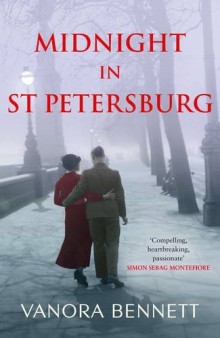
midnight-st-petersburg-220x338As political tensions escalate, Inna finds herself torn between two men who represent very different paths. Wild and quick-tempered, Yasha throws himself into revolutionary politics with abandon. Their relationship, while built on passion and desire, also has the potential to destroy the safety of the life that Inna has created. On the other hand, respectable Englishman Horace, with a position at the prestigious Fabergé jewelry house, represents security and steady, unerring loyalty.

As the situation in St Petersburg becomes increasingly dangerous, Inna is forced to choose between following her head or her heart.

I loved this book. Set in one of the most tumultuous periods of Russian history, the reader experiences some of the most important events of the period through the eyes of an ordinary family who are just trying to live and to stay afloat. From a historical point of view, we’re introduced to some of the key figures of the time, from Rasputin to Lenin, and it really shone a light on the cultural and religious differences of the people living in St Petersburg at the time and the how events impacted on these different groups.

As someone who’s trying to learn Russian (albeit extremely slowly!) I really enjoyed how the author added little details explaining the nuances of Russian language and customs. I can only imagine how tough it would have been – and probably still is – to live in Russia as a foreigner. I also loved that the character of Horace was based on the real life story of the author’s great-uncle, it gave the novel a really personal touch.

One thing that I would say is that it took me a while to get really into the story. I didn’t immediately relate to Inna as a character, I found she came across as quite dispassionate and almost calculating. That said, as a young Jewish woman fighting for her survival, that’s probably exactly who she needed to be, and the tone contributed to the overall feeling of distrust and of tension revolutionary Russia. Still, it would have been great to have a bit more information about the central characters earlier on in the novel, as it might have helped me to become emotionally invested in them a bit earlier on.

By the end though, I was completely hooked. It was fast paced, packed full of tension and led up to a really satisfying conclusion. A definite must read for anyone interested in historical fiction!

(Massive thanks to the publishers for the review copy – much appreciated and enjoyed!)

A review of Julia Gregson’s Jasmine Nights

As I’ve no doubt mentioned before, I have a soft spot for historical novels. I especially like it if these historical novels happen to focus on a subject that I know relatively little about. As any reader will know, World War II has – quite rightly – inspired a whole plethora of books over the years, and in my experience it’s quite rare to come across one that has a completely fresh take on the genre. However, Julia Gregson’s Jasmine Nights managed to do just that.

Jasmine nightsFar away from the trenches of central Europe or the grey, rationed world of 1940’s London, Jasmine Nights presents a completely different aspect of war experienced in the exotic cities of Cairo, Alexandria and Istanbul and the open skies over the Egyptian desert.

Against the wishes of her family and in a move may alienate her from her father forever, ENSA singer Saba has risked everything to pursue her passion and to serve her country. Egypt offers her a chance to grow in ways that she could never have imagined, but as the war progresses she finds herself increasingly embroiled in the shady world of espionage, with devastating consequences.

Pilot Officer Dominic Benson, serving with the Desert Air Force, has recovered physically from a traumatic injury but is struggling with the guilt of losing his best friend. When he hears Saba singing in a hospital concert, he dares to hope again. But taking to the skies again comes with it’s own dangers, and when disaster strikes, can they find their way back to one another?

The switching narratives give an insight into two very different sides of war, from Saba, fighting for her independence from the constraints of home, to Dom, who has experienced the all the horrors of war first hand but can’t bring himself to talk about it. At it’s heart, it’s essentially a romance novel, and yes, it does have some clichés and yes, the characters could have been developed a little further, but that didn’t stop me from thoroughly enjoying it.

Prior to Jasmine Nights, I hadn’t read much about WWII in Africa, and this book was packed full of vivid visual imagery and a wealth of detail and description that spoke to all the senses. I listened to this as an audiobook, mostly on my way to and from work, and on several occasions found myself loitering in the snow because I couldn’t bring myself to turn it off! The protagonists are interesting and appealing and there’s enough tension and intrigue to keep you hooked all the way to the end. Above all it’s entertaining, what more do you need?

Book bribery or just clever marketing?

Over recent months, the decline of the British high street has showed no sign of slowing. And although fashion retail has suffered some major hits, it’s arguably electronic, book and video game stores that have the most to fear from online retailers and supermarket chain contenders, with major names such as Jessops, HMV and Blockbuster falling into administration in 2013 alone.

WaterstonesWhen it comes to bookshops, the collapse of Borders in 2011 is a stark reminder that it’s not just independent stores that are at risk – but that seemingly well established, international brands are also just as vulnerable. In fact, despite their strong corporate support system, I’d argue that larger chains have their own difficulties in that they may struggle to build a personal connection to their customer base.

One retailer that’s trying to buck the trend is Waterstones. In a bid to boost sales and to challenge the rise of e-readers, this high street heavyweight has recently announced a new initiative that will see it team up with popular authors to offer exclusive bonus content. The business has signed a deal with Chocolat author Joanne Harris for an additional, non-plot essential chapter for her latest novel – Peaches For Monsieur Le Curé – which will be only available in copies purchased from Waterstones.

But as readers, what do we think of this new initiative? On the one hand, I can’t help but feel that authors should want their book to be the best that they possibly can be, regardless of who’s reading it or where they’ve purchased it from. Their reasons for signing up to the scheme may have stemmed from the best of intentions, but at the end of the day some fans are going to miss out, whether that’s through ignorance of the existence of Waterstone’s extra material or for financial reasons.

That said, is the Waterstones scheme really that different to others that have preceded it? The Richard and Judy Book Club for example, which is available exclusively at WH Smith, has long since offered readers additional reading material and discussion points, while many publishers choose to offer a sample chapter of the authors next novel as a teaser. And moving away from books for a second, DVD’s often provide viewers that chance to access deleted scenes or interviews with the cast.

At the end of a day, a business is a business and in these challenging economic times everyone has to think of new and innovative ways to make money and increase their profit margins. With online retailers and larger supermarket chains now able to offer significantly reduced prices, leaving traditional high street stores struggling to compete, the promise of additional material is just one way of helping stores like Waterstones to stand out from the crowd and to offer customers more for their money.

As for me – I’m torn. I can see the advantages of these initiatives from a marketing perspective and in theory I’d love to buy all my books from Waterstones. But in reality I just can’t afford to, especially not with my reading habits! If anyone has any thoughts on this, let me know!

Happy Mother’s Day!

On a good day, I live a four hour drive away from my mum, and today she’s actually on holiday in Germany so she’s even further away than ever. And as I won’t be seeing her to say Happy Mother’s Day in person, I thought I’d write a post dedicated to her instead.

She’s always there for me, keeping me company on the phone, answering obscure cooking questions on demand and letting me vent if I’ve had a particularly crap day. She always goes after what she wants, whether that’s learning something new or finding the new dream home (hopefully she’ll find one soon!), and she’s got a whole host of (slightly mental!) hobbies and talents, from shooting, art or acupuncture to chocolate making or belly dancing!

So for my Mum, I miss you and I love you and I can’t wait to see you soon.
Mum 3Mum 2Mum 1


Campaigning for women worldwide

iwd_squareToday, March 8th, is International Women’s Day. In honour of the event, I’m taking a slight detour from my usual literary topics to try and raise awareness of some of the issues facing women across the world, and in particular, in South Africa.

Last month, while reading Cosmopolitan magazine’s special feature on International Women’s Day, I came across a shocking statistic, so shocking in fact that I felt compelled to write about it. A massive 37% of South African men admit to rape, although only a tiny percentage of these crimes are reported. What makes this worse is that South Africa has a 24.8% HIV & AIDS infection rate, affecting an estimated 5 million adults and children. The high rape count could be considered a driving factor behind that fact that the majority of new cases of HIV infection are women or girls (unfortunately, some men in the country still believe that sex with a virgin can cure AIDS, resulting in a high number of increasingly young victims).

One organisation that’s committed to helping address this issue is VSO (http://www.vso.org.uk/), an international development charity that works with communities across the globe. In particular, it’s doing a lot of work in South Africa to achieve equality for women. With one in four women fleeing their homes as a result of domestic violence, the work of charities in this area is vitally important. Many women are also financially dependant on men and face the additional challenge of caring for family members living with, or orphaned by, AIDS related illnesses.

International Women’s Day is a great opportunity to raise awareness of the issues – like this one – that women worldwide face on a daily basis, so this is just a quick shout out to encourage everyone to take the opportunity to help spread the word and to do something to support the efforts of these charities, not just today but all year round.

* all facts are sourced from the VSO website (here) and Cosmopolitan March 2013 issue, p73

Review of Gillian Flynn’s Gone Girl

With over 2 million copies sold worldwide, Gillian Flynn’s Gone Girl was one of the most talked about books of the last year- and rightly so.

Gone GirlA dark and disturbing thriller, Gone Girl is the story of the disappearance of a seemingly perfect wife on her fifth wedding anniversary. For Nick, left behind in smalltown Carthage, Missouri, Amy’s disappearance plunges him into a waking nightmare. As the police and the American public begin to turn against him, it’s clear that something about his take on recent events doesn’t quite add up.

The first part of the novel switches between Nick’s first hand experiences of the days immediately after the disappearance and Amy’s diary entry’s, dating back to the day that they first met. But as the book progresses, we begin to realise that the two narratives we’re hearing are telling very different stories, and that at least one of the two of them is not telling the whole truth. In fact, they’re telling anything but the truth.

Then – and there are spoilers coming up so if you don’t want to know, don’t read ahead – the second half of the book hits and we realise that we have two very unreliable and wholly unlikeable characters on our hands. Both Nick and Amy are lying, concealing and misleading both themselves and the reader. It’s a bold move from Gillian Flynn, as she runs the risk of alienating her audience. Not everyone wants to read a whole novel with central characters they can’t relate to.

But in this case, it’s a risk that really paid off. Nick and Amy are human and throughout the novel they display very human weaknesses. Whether they have any redeeming qualities is a very different matter.

Gillian Flynn really ramps up the tension and holds her readers in suspense the whole way through. I was hooked and couldn’t put it down until I turned last pages in the (very) early hours of the morning! Ultimately, in Gone Girl Gillian Flynn has created a master psychological thriller that thoroughly deserves the praise that has been heaped upon it.