‘The Girl with All the Gifts’ by M. R. Carey

The girl with the giftsTen-year-old Melanie’s world consists of the four walls of her room, the corridor and the schoolroom. She loves school, and even more so if it’s Miss Justineau’s day to teach. To all extents and purposes, Melanie seems just like any other little girl, but it soon becomes clear that all is not what it seems. Every time Melanie leaves her room, she’s strapped into a wheelchair, unable to move or even turn her head. Her classmates have a habit or disappearing and never coming back, and the guards never relinquish their grip on their guns.

It’s hard to go much further without giving away spoilers, but we soon find out that Melanie and her classmates are anything but normal children. In the wake of an unexpected and deadly event, society is struggling to survive. Melanie’s schoolroom is on a scientific army base, where people are desperately searching for solutions, whatever the cost. Continue reading

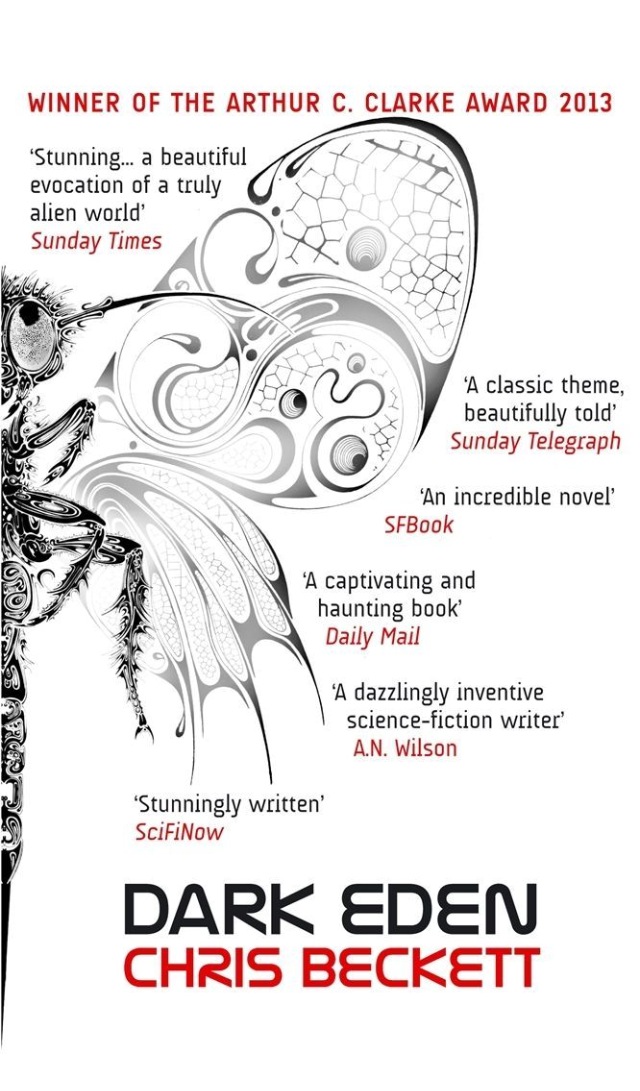
‘Dark Eden’ by Chris Beckett

Dark edenIf you read this blog regularly, you’ll know that I’m happy to try most genres. ‘Dark Eden’ got great reviews and it was reduced to 99p on Amazon, so even though it was a bit of a different premise than I usually go for, I thought I’d give it a try. Honestly, though, this went a little bit too far into the realms of science fiction for me. The world building was good but a little too much for me to get my head around.

Essentially, ‘Dark Eden’ is the story of a group of people stranded on a planet far from earth. Set far in the future when space travel is the norm, a rogue ship slips through the cracks and ends up stranded on a planet that’s completely off the grid. This world is completely new – there’s no sun, the light coms from flowers and the heat comes from the trees. Due to the perpetual darkness, there’s no real concept of time, and the people have to come up with their own methods for measuring out their days.

Mimicking biblical origin stories, all of the children born on the planet are descended from one couple, meaning that a lot of the children are born with physical or mental abnormalities. In theory, this was an interesting idea, as it had the potential to raise all sorts of questions about where we get our belief systems, our idea of right and wrong and our social structures. In practice though, I found it weird and I felt a bit uncomfortable reading it. Continue reading

Koethi Zan’s ‘The Never List’

The Never ListBest friends Sarah and Jennifer list by the ‘Never List’ – a set of rules which dominate their lives. Above all, never take risks. But despite all their planning, the worst happens, and the girls are thrown into the middle of their worst nightmare.

Ten years later, Sarah is trying to move on with her life. But she’s still tormented by the past and trapped in a prison of her own making, and it seems that her persecutor hasn’t forgotten her. To give herself any chance of having a normal future, Sarah must face up to her demons. But is she putting herself back in harm’s way? And will what she is about to discover destroy her forever?

Koethi Zan’s The Never List was quite readable, but to me, it didn’t feel like it really offered anything new to the genre. The characters are described as going through some intense emotions, but they never really came alive to me and fell a little flat. The story trundles along well and picks up pace with some well-placed action scenes towards the end, but the twists were disappointingly predictable.

The author plays on society’s fears of hidden sociopaths disguised in plain sight. Continue reading

‘The King’s Curse’ by Philippa Gregory

The latest installment in Philippa Gregory’s Tudor epic follows the life of Margaret Plantagenet, Countess of Salisbury. The daughter of Isabelle Neville and George, Duke of Clarence, granddaughter of the Earl of Warwick, also known as the Kingmaker, and the niece of two kings, Edward IV and Richard III, Margaret is no stranger to the perils that come with being close to the throne. Her brother Edward was locked in the tower from boyhood and executed, her cousin Elizabeth married to the Tudor usurper, Henry VII and her father drowned in a barrel of wine.

With her title stripped from her, she is married off to a Tudor loyalist and renamed plain Lady Pole. But she can’t escape her lineage, and is soon drawn back into the centre of the scheming and unpredictable Tudor court. Keeping the household of her cousins oldest son and heir to the throne, Arthur, Prince of Wales, Margaret becomes a close friend and confident of his young bride, Catherine of Aragon. Over the years, Margaret witnesses Catherine marry Arthur’s younger brother, the soon to be Henry VIII of England. She stands by her side as she loses child after child, and takes on the role of governess and protector to the treasured Princess Mary.

But when his wife fails to give Henry a male heir, Margaret has no choice but to watch as Catherine slips from his favour. Through the troubled times ahead, as more and more people are sent to the tower and the executioners block, Margaret has to make a choice – whether to defy the king and stand up for what she believes in, or to pull back and protect her family in any way she can.

Over the course of the novel, we watch as Margaret transforms from a scared young woman desperate to fly under the radar to a powerful matriarch in her own right, advancing herself and her family by asserting her rights as a member of one of England’s most influential families.

Comparing this latest novel to the previous books in Gregory’s ‘Cousins War’ series, Margaret stands out as a woman who is able to influence events and wield real, demonstrable power. She is one of few women to be made a peer in her own right without a husband, she runs her households and business with precision and, in Philippa Gregory’s imagining, she guides each and every member of her family in their careers and choices. She is the one who makes decisions about if and how they will make a stand against the King, and as a true Plantagenet, her name gives her the authority to influence the common people.

She’s an interesting character to get an insight into, and Gregory, as the undisputed queen of this genre, has a gift for creating characters with strong, believable voices that bring the past to life.

‘Smiler’s Fair’ by Rebecca Levene

Smiler’s Fair is the first book in a new fantasy series by Rebecca Levene.

Many years after a war between the moon god and the sun goddess tore the world apart, people are still living with the after effects. Prophecies are rife, gods are many and the people are restless. Darkness and shadows bring the worm men, servants of the moon, who will destroy everyone in their path. To avoid them, great floating cities grace the countries lakes. Those that live on land have wheels beneath their homes, constantly moving onwards.

Smiler’s Fair is a huge mobile community, setting up shop and selling any number of vices to the people that flock through its gates, before moving along before the worm men can come. It’s rarely in the same place twice, but it attracts a boiling pot of cultures, races and desires. For the characters in this book, it’s a hiding place, a fighting ground, a way of life or a form of employment. Prophecies, fear and anger drive them together, acting as a catalyst for a war of gods and men that have the potential to change the shape of the world forever.

The author has created a huge new fantasy world here, which should have any number of possibilities. There are numerous different clans and kingdoms all brought together in one vast landscape, taking us on a journey from the snow and mountains to deserts and open plains. We’re introduced to a whole range of characters and narrators with constantly changing fortunes. There’s also an overarching supernatural element that gives events a wider context, helping to drive the story forward. All the ingredients are there. But unfortunately, it didn’t quite live up to expectations.

My main issue with this book is that there seem to be lots of random unconnected stories that seem to have any relevance to the overall story. The different strands felt disjointed and never really came together. There were too many narrators and it felt more like several different books. Having fewer viewpoints would have helped. As it stands, it got confusing and hard to keep track of who everyone was. There wasn’t enough of a central story to bring everything together.

I liked Dae Hyo. I bought into his back story and felt like he really fitted the world that he was in. I liked the son of Nethmi’s husband. He showed some real character and turned out to be much more than he seemed at first. I also liked Krish, he seemed to have real potential to evolve as a character and I would have liked to read more about him.

But I thought the sections with Nethmi and Marvan were almost superfluous, and they could easily have been incorporated as minor character in other people’s stories. The ending would have worked equally well without them in it and it felt like all the time I spent reading about them was a bit of a waste of my time.

I didn’t particularly like many of the characters. There was a lot of time spent talking about their vices or how physically attractive they were, but very little on their redeeming qualities. Some, like Eric, may get more interesting later in the series, but it felt like many stories had only just been begun when the book ended.

To me, this felt like half a book. I didn’t race to the end, more like I turned the last page and thought – ‘Oh. Is that it?’. I was constantly waiting for it to really get started. Maybe this is a tactic to get readers to buy the next book in the series when it comes out, but if it is, it hasn’t worked on me.

A futuristic thriller

Tomorrow and tomorrowThomas Sweterlitsch’s ‘Tomorrow and Tomorrow’ is set in the not-to-distant future, when technology has advanced. In the place of smartphones, people have software installed directly into their heads which is connected to the internet and connected to retinal display screens. People’s social media profiles are displayed automatically as they walk past, advertisements are videos that stream directly into your hear when you glance their way, instead of business cards people can just push their details straight into your address book and news streams offer constant real time updates in the corner of your vision.

Another new feature of this world is a virtual archive of the city of Pittsburgh, which has been completely destroyed by a dirty bomb that obliterated the city’s entire population. The archive is made up of video footage, taken from personal streams, social media sites as well as traffic, surveillance and security cameras. People are able to visit the archive, going to any time, any place and anyone and reliving the past through augmented reality software.

Dominic was one of Pittsburgh’s survivors, out of the city when the deadly bomb struck, but lost his wife and unborn child. He works in the archive, tracking down people and reliving their last hours to help settle insurance claims. He also spends a huge amount of his time living in the past – reliving the same memories of his wife, following her final moments and hearing her speak to him again and again. Continue reading

‘The Daylight Gate’ by Jeanette Winterson

the daylight gatePublished in 2012 to coincide with the 400th anniversary of the Pendle Witch Trials, one of the most well documented examples of witch hunts in English history, this novella combines established facts and records with a rich imagined backstory to help brings events to life.

The book focuses on Alice Nutter, one of the eleven people accused of witchcraft and tried in the August Assizes in 1612. Alice was unique in the fact that she was a gentlewoman and relatively wealthy compared to the rest of the accused.

Jeanette Winterson creates an atmosphere that evokes the culture of 17th century England – one of fear and fanaticism, complete with a paranoid King intent on destroying both witches and Catholics. It’s gritty and grim and bleak and it doesn’t romanticise poverty. There’s no scrimping on the details when it comes to hygiene, health or squalid living conditions. Grave robbing, torture and corpse mutilation all feature in their turn and at times it’s quite hard to read.

She uses the known facts and the details of the trial to give her characters motivations, backstories and personalities. The Idea of witchcraft is portrayed in numerous very different ways. For the most part, ‘witchery’ is something that people were accused of out of fear or anger. It’s also something of a religion to some of the poorer people, who out of desperation may believe in anything to help them survive. To the village healers, it’s a profession. To Alice Nutter and her companions, in this story at least, it’s something more real, dangerous but full of potential. Continue reading

‘Tigers in Red Weather’ by Liza Klaussmann

TigersCousins Nick and Helena have grown up together, spending long, hot summers on Tiger Island. Having themselves become wives and mothers, these summer trips remain a yearly tradition.

Captivating and enticing, Nick is also volatile, selfish and unpredictable, her marriage is troubled by secrets and things left unsaid. By contrast, Helen has always been the quieter of the two, the one more willing to bend to Nick’s will. But in the heat of the summers, long buried resentments, jealousies and frustrations are quick to come to the surface. Through the decades, a storm is brewing that threatens to destroy everything and to test the ties of family, love and duty to their absolute limit.

I really liked the way this book was written. The author manages to evoke an impression of life in post war America beautifully, and the heat and oppression of the long summer days are conjured up so vividly they are like a separate character all on their own.

However, for me it felt like this book was more style over substance. Continue reading

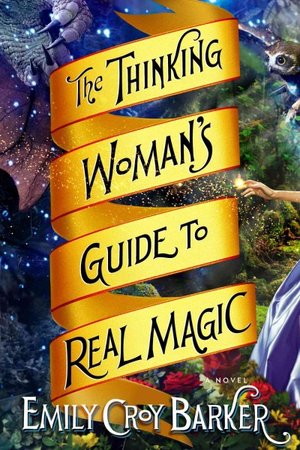
Emily Croy Barker’s ‘The Thinking Woman’s Guide to Real Magic’

thinking womans guideDespite disliking the main character so much I almost quit halfway through, once you get stuck into this book it isn’t half bad!

The first part of this book is pure fairy tale. Our main character, Nora, stumbles upon a beautiful house and gardens deep into the forest. Soon, she’s drawn into the chanting and intoxicating world of Illisa and her friends. Caught up in a whirlwind of parties and swiftly married off to Illisa’s son Raclin, it’s only much later that she starts to regain her faculties enough to understand that she’s been enchanted from the second she clapped eyes on Ilissa, and that the Faitoren are much more than they seem. Desperate to escape their clutches, she flees and is rescued by the magician Aruendiel.

Away from the Faitoren, Nora finds herself in a world reminiscent of Medieval England. With no way to get back to her old life, she learns to adapt to life in his household. This brings some challenges in terms of how conceptions of power and gender are viewed compared to what she’s used to.  Initially, Nora’s relationship with Aruendiel is fraught and strained, with her essentially being an initially unwelcome, dependant houseguest who has yet to prove her worth. Eventually though, they start to work out their differences after she persuades him to start teaching her basic magic. And when Ilissa and Raclin make a play to kidnap Nora back, they trigger the start of a war that’s been a long time coming. Continue reading

‘The Golem and the Djinni’ by Helene Wrecker

GolemIn early twentieth century New York, a Golem wakes without a master and a Djinni is released from a bottle after years in captivity, bound in human form.

Created out of clay, the Golem has one single purpose, to protect her master and serve his needs. But when he dies crossing the Atlantic, she is left utterly alone and overwhelmed by the flood of human desires and emotions in the bustling city. Taken under the wing of a Jewish Rabbi who recognises her for what she is, the Golem struggles to overcome her instincts and to live a life disguised as a human within the tight Jewish community.

Elsewhere, in a Middle Eastern neighbourhood, a man repairing a metal flask is stunned by the appearance of the Djinni on his shop floor. The Djinni, having been trapped for thousands of years inside the flask and bound by iron cuffs that keep him assuming from his true form, is forced to take refuge as an apprentice at the metal shop in order to blend into his surroundings.

But even as they both adapt to their new lives, the Djinni never stops searching for a way to break his bonds and the Golem searches for answers and a way to be free to show her true self. Meeting by chance, they spend their nights wandering the city streets and parks, forming a friendship that helps them to get through the days they spend pretending to be human. Far away in Europe, a man sets out across the ocean. Dangerous and powerful, he threatens everything they have, but he might hold the key to setting them free. Continue reading