Emily St John Mandel’s Station Eleven

Station ElevenIn Station Eleven, 99% of the population has been wiped out by the Georgian Flu. Towns and cities have been deserted, as people set out to escape the flu, which spread quickly and without mercy throughout densely populated areas. Instead, settlements have sprung up wherever people ended up when they ran out of fuel – around petrol stations or fast food restaurants – or at hotels or defunct airport lounges.
It starts with the death of Arthur Leander, who collapses on stage whilst performing King Lear at a Toronto theatre, just days before the collapse. Arthur dies in the old world, but the lives of people who knew him wind throughout the past and the present. From his ex-wives to the young child actress playing a walk-on part in Lear, he is the glue that holds the novel together.

Twenty years in the future, the national grid is down. The survivors have no electricity. Even if they can discover ways to generate their own power, the internet is down. Modern communication methods no longer exist. Kirsten, the child who once performed in King Lear, is now part of the Travelling Symphony, travelling the country performing plays by Shakespeare. They offer people much needed and wanted entertainment as they rebuild their lives again from scratch. But when travelling through one settlement, it becomes clear that something is wrong. The symphony is threatened, and has to pull together and rely on all their wits to avoid falling into the clutches of the dangerous self-proclaimed ‘Prophet’.

In the past, Arthur’s first wife, Miranda, struggles to cope with the pressures of life of Hollywood, while Elizabeth, his second, takes her young son to live halfway around the world. Arthur’s college friend, Clark, remembers the person that he used to be. Arthur’s death is a catalyst that throws them all back together.

But the backbone of this story isn’t about the plague itself, and it’s not really about the symphony’s altercation with the Prophet, which provides just a loose framework and structure for the novel. There are no huge battles for supplies or survival. Instead, this book is about how people adapt and change as a result of events that have changed the world beyond recognition. It’s about the relationships that people form and the search for answers behind a natural disaster. Continue reading
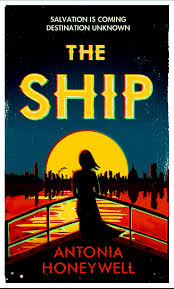
Discussing Antonia Honeywell’s ‘The Ship’

The ShipI was lucky enough to be selected as a member of the Curtis Brown Book Group, and Antonia Honeywell’s debut novel ‘The Ship’ was the first book up for discussion. It was a great pick, and there are so many points for discussion that it’s hard to know where to start!

Sixteen year-old Lalla has been raised in a world that is slowly disintegrating before her eyes. Floods, banking crashes, food shortages and disease have destroyed parts of the world and driven the survivors into small, isolated pockets. Every citizen is required to keep themselves registered. Without their cards, they are no longer considered to be the responsibility of the government and are liable to be shot on sight. The homeless and the unregistered are forced to seek shelter wherever they can – from a tent city in Regents Park to the British Museum or St Paul’s Cathedral.

For as long as she can remember, Lalla’s parents have been talking about the Ship – the vessel that will lead them to a better place along with five hundred carefully selected ‘worthy’ souls. But when Lalla finally makes it onto the promised Ship, she can’t shake the feeling that there’s something deeply wrong. She’s plagued with questions that no one is willing to answer – where are they going, who are they leaving behind, and ultimately, what are they living for? Continue reading

Roopa Farooki’s ‘The Good Children’

the good childrenRoopa Farooki’s ‘The Good Children’ focuses on the lives of the Suddeq family in Lahore, the Punjab.

From birth, the Suddeq children – Sully, Jakie, Mae and Lana – are pushed into set roles determined by their gender and by social expectations. The boys will study, go abroad for education and return as successful doctors. The girls will be dutiful daughters, marry well and help to keep the family in the highest social standing.

But their mother’s determination to force them into these ideals of ‘good children’ forces a wedge between her and her children. All four grow up to rebel and push the boundaries in their own way – Sully marries outside of his religion and Jakie falls in love with a white Irishman, while the girls leave their husbands and raise their children with Western values.

Despite scattering to all corners of the globe to escape their mother’s grasp over their lives, their childhood in the Punjab profoundly affects all four of the children. As they build their lives in new surroundings and carve their own path away from family and cultural expectations, they all struggle to some extent with feelings of enduring guilt or resentment. Many years later, they are drawn back to their childhood home and forced to come to terms with their upbringing and the choices they’ve made since. Continue reading

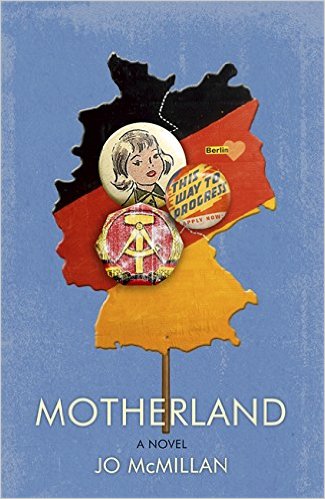
‘Motherland’ by Jo McMillan

MotherlandGrowing up as the only child of the only communist in the Midlands town of Tamworth, Jess has felt like she’s ‘different’ all her life. When her mother, Eleanor, gets the opportunity to spend time in East Germany over the summers, her and Jess jump at the chance. Living in the German Democratic Republic (GDR), they begin to feel like they’ve found a place where they finally fit in.

While in Tamworth, Eleanor was the butt of every joke, in East Germany she is valued and appreciated. When they meet Peter, a widower, and his daughter Martina through the party, it seems like the final pieces might be starting to fall into place. But it soon clear that the Party comes first, and personal relationships that don’t meet with approval from the top are forced to come second.

Jess is the main character – we see through her eyes and are heavily influenced by her views. Despite this, the character that I emphasised the most with was Eleanor. She clearly has incredibly strong beliefs and a tireless commitment to a cause that she believes in completely – even when she’s spit on, ground down and disappointed. Her steadfast commitment to her values doesn’t even waver when her chance at true love is whisked away by the party. I admire her for sticking to her convictions through thick and thin, but can’t help but think that she’s choosing a life that doesn’t necessarily lead to her being very happy. Continue reading

‘Mr Penumbra’s 24-hour Bookstore’ by Robin Sloan

Mr PenumbraWhen unemployed graphic designer Clay takes a job working nights at Mr Penumbra’s 24-hour bookstore, all he wants is a job. But it soon becomes clear that the bookstore, and its enigmatic owner, are more than they seem.

As well as the traditional books you’d expect to find in a bookshop, there’s also a second set of books – written in code and hidden away from the eyes of prying customers. Throughout the quiet night shift, an assortment of people occasionally hurry in to borrow one of these books, whilst returning another. Clay’s role is to note down what book is borrowed with a description of the borrower, but not to ask questions.

Inevitably, Clay starts to wonder about what this strange collection of people are up to. Finding the codes unintelligible, he and his friends instead draw on their technological skills to help track the pattern of borrowing in a way that they can understand. Unwittingly, he soon uncovers a clandestine literary society working to decode the mysteries around a centuries’ old secret. Continue reading

‘A Place called Winter’ by Patrick Gale

a place called winterWhen Patrick Gale’s latest novel opens, protagonist Harry Cane is incarcerated in a mental asylum. As we read on, we find out more about his life and how he ended up there.

Born as raised in England as the eldest son of a wealthy businessman, Harry lives a relatively idle life. Shy and with a stammer that embarrasses him, he enters into a happy but platonic marriage. When he enters into an illicit, passionate affair, he starts to discover more about himself and his sexuality.

When he’s inevitably discovered, he’s forced to leave his family behind under the threat of scandal and imprisonment. Harry emigrates to Canada, where he’s allocated a remote homestead in a place called Winter. It’s a harsh environment, and to succeed in his new life Harry has to learn a whole new set of skills – building a home from scratch and clearing his land for farming.

On his travels he meets Troels, a dangerous and sadistic man who makes a living from exploiting the many homesteaders that fail in their efforts to start afresh in the Canadian prairies. His relationship with Troels is dark, twisted and unsettling, and his negative influence pervades the whole book, even after Harry forms a new bond with his neighbour, Paul, and his sister, Petra. Eventually, this troubled relationship forces Harry to make a terrible decision.

Harry at the beginning of the novel is shy, withdrawn and has no real purpose in life. He drifts aimlessly, whiling his days away as best he can. His marriage and its breakdown, plus the irrevocable spilt with the only family he has, shakes him to the core – but it also wipes the slate clean in a sense. After his enforced new start in Canada, he discovers the value of working for himself, a sense of achievement and real love and friendship for the first time. Continue reading

Antoine Laurain’s ‘The President’s Hat’

the presidents hatEverything begins when Daniel Mercier sits down for dinner on the table next to the French President, Francois Mitterrand. When the president gets up to leave, he leaves behind his hat. Daniel seizes the opportunity and takes the hat with him as he leaves.

When he wears the hat, Daniel seems to feel different somehow. He’s more emboldened, more confident, more direct and ultimately more successful. It’s as though putting the hat on his head has allowed him to come out of his shell and become the person he should always have been. Astonished by his good luck, Daniel clings to the hat as a symbol of everything he’s achieved. That is, until he leaves the hat on the train and it’s picked up by a new wearer, who might just need a little inspiration of her own.

From here, the hat continues to change hands while Daniel continues his hunt to get it back again. Wearing the hat seems to give each character the motivation they need to make changes in their lives. As readers, we’re left to wonder whether this newfound confidence really comes from the hat, or if the hat is just a catalyst that unlocks what was there all along.

It also raises the question of fate, and how we have the ability to make our destinies and to carve out the path that we want, even if it might seem impossible. Continue reading

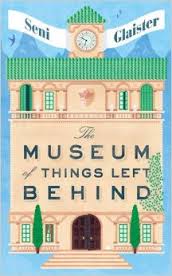
‘The Museum of things Left Behind’ by Seni Glaister

Museum of Things Left Behind‘The Museum of Things Left Behind’ is set in the entirely fictional country of Vallerosa, which is supposed to sit somewhere in the middle of Switzerland, Italy and Austria.

Lizzie, a British student, arrives in Vallerosa aiming to widen her horizons, intending to give to those judged less fortunate than herself by helping out in a hospital, orphanage or similar institution. What she finds is very different.

Run by an elected dictator, who inherited the job from his father, Vallerosa’s government seems entirely hung up mindless bureaucracy – a committee to decide the name of a committee or a meeting with the under-secretary to arrange a meeting with the Secretary.

Positions of power are inherited, women are scarce and the President himself is consumed by self-doubt. The country is neatly divided into those in government and those that are more working class – and the two groups really mix socially. But at the same time, everyone is educated, employed, healthy and generally happy.

Lizzie is initially at a loss as to what to do with her time. But she quickly learns that she can give seething back to this country, albeit not at all in the way she’d planned. Confusion over her identity pushes her straight into the heart of government, giving her a unique opportunity to see life from the viewpoint of the countries many dedicated officials. At the same time, she goes out of her way to speak to ordinary people. Initially, she sets out to find a way to fix the town clock, and in doing so, she may have the opportunity to bring the country even closer together.

At the same time, Vallerosa might also be able to give her something that she didn’t have before – a new sense of self-awareness and an appreciation for a simpler, more honest way of life. Continue reading

Jane Smiley’s ‘Some Luck’

some luckSome Luck follows the lives of Walter and Rosanna Langdon, year by year from 1920 to 1953. From a young couple starting their lives on a farm in Iowa, the book follows their family as it grows and expands, following them across the country and beyond as they find love, go to war, discover new things about themselves and have children of their own.

All of this is set against the backdrop of wider global issues taking place at the time, placing this one fictional family firmly in the middle of some of the most important events of America’s twentieth century – from the Great Depression to the prohibition to the Second World War and the beginning of the Cold War.

Walter and Rosanna are a typical Midwest rural farming couple, and they raise a family in the hope that their children will go out into the world and choose their own paths. They sacrifice everything they have to keep their family going – enduring drought, falling prices and poverty to make sure that there’s food on their table and that their children never go without an education. Continue reading

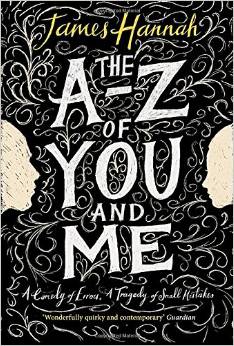
James Hannah’s ‘The A-Z of You and Me’

A-ZIvo, aged just forty, is dying of kidney failure in a care home when nurse Sheila tasks him with making his way through the alphabet, thinking of a story for each part of the body. Each letter inspires a kaleidoscope of different memories, as each body part takes him back to a different moment, feeling or person. As he works his way through the body, starting at Adam’s Apple, we gradually build up a picture of how his life has played out and how he’s ended up in the hospice.

For the most part, Ivo’s memories are dominated by two people – his ex-girlfriend Mia and his best friend Mal. Friends since they were at school, Mal has always been the reckless, outspoken leader of the group. As they get older, Mal and the rest of Ivo’s friends draw him into destructive cycle of drugs and alcohol. When he meets Mia, he gets a taste of what life could be like if he followed a different path. As his memories unfold, we’re thrown right into the middle of the key defining moments of his life to witness as Ivo makes choices that could affect the course of his future forever.

I didn’t find Ivo to be the most sympathetic of characters – and this may be down to the matter of fact and brutally honest writing style of author James Hannah, which exposes his characters’ every flaw. His life is filled with regrets and things that he should have done differently. He deliberately neglects his health, wilfully ignoring the seriousness of his diabetes diagnosis. Mal is undoubtedly a bad influence, but Ivo shows very little restraint, is easily led and refuses to take responsibility for his actions. Even though he loves his Mia, his choices keep pulling him away from her at every turn. In the end, his devil-may-care attitude has devastating and irreversible consequences. Continue reading