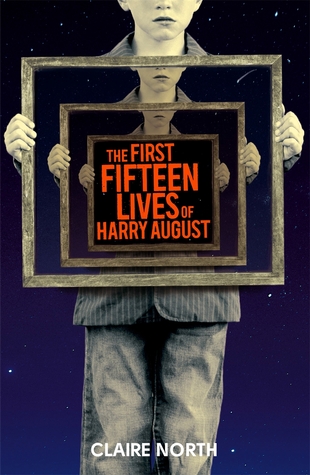
‘The First Fifteen Lives of Harry August’ by Claire North

first 15livesofharryaugustIn the First Fifteen Lives of Harry August, author Claire North plays with our concept of time. In her vision, time runs over and over on a constant loop. Some people have the ability to retain their consciousness from one life to the next, and are born again and again – always in the same time, in the same place and to the same parents, but with the knowledge of the lives lived before.

Here, being reborn isn’t reincarnation, it’s more like doing endless laps around a track. People like Harry cross paths with the same acquaintances every life, and develop relationships that span more lifetimes than they can remember. Major events and landmarks pass by again and again, and even with their extensive knowledge, there’s nothing they can do to stop or change them.

For Harry and those like him, life is both a constant experiment and a bit of a bore. Childhood is a chore to get through. Death isn’t final and is sometimes, in extreme cases, welcomed. But then news of a disaster starts to filter through from the future. The end of the world is coming, and it’s getting closer with every generation. Someone is disrupting the balance, inventing technology far before its time with devastating consequences. When people start disappearing, murdered in the womb before they can be born and breaking the cycle for good, it becomes obvious that this threat is very real. Continue reading
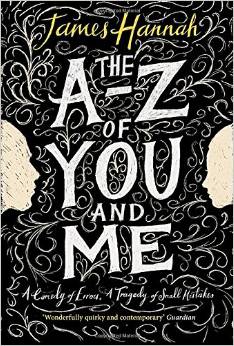
James Hannah’s ‘The A-Z of You and Me’

A-ZIvo, aged just forty, is dying of kidney failure in a care home when nurse Sheila tasks him with making his way through the alphabet, thinking of a story for each part of the body. Each letter inspires a kaleidoscope of different memories, as each body part takes him back to a different moment, feeling or person. As he works his way through the body, starting at Adam’s Apple, we gradually build up a picture of how his life has played out and how he’s ended up in the hospice.

For the most part, Ivo’s memories are dominated by two people – his ex-girlfriend Mia and his best friend Mal. Friends since they were at school, Mal has always been the reckless, outspoken leader of the group. As they get older, Mal and the rest of Ivo’s friends draw him into destructive cycle of drugs and alcohol. When he meets Mia, he gets a taste of what life could be like if he followed a different path. As his memories unfold, we’re thrown right into the middle of the key defining moments of his life to witness as Ivo makes choices that could affect the course of his future forever.

I didn’t find Ivo to be the most sympathetic of characters – and this may be down to the matter of fact and brutally honest writing style of author James Hannah, which exposes his characters’ every flaw. His life is filled with regrets and things that he should have done differently. He deliberately neglects his health, wilfully ignoring the seriousness of his diabetes diagnosis. Mal is undoubtedly a bad influence, but Ivo shows very little restraint, is easily led and refuses to take responsibility for his actions. Even though he loves his Mia, his choices keep pulling him away from her at every turn. In the end, his devil-may-care attitude has devastating and irreversible consequences. Continue reading

Giving a classic new life

Keeping teenagers reading books for fun has long been a challenge for parents and the publishing industry alike – although the young adult market has exploded over recent years with authors like Stephanie Meyer and Suzanne Collins hitting the big time when they successfully made the crossover from the shelves to the big screen. But while the YA market is booming for paranormal, dystopian and coming of age novels, encouraging a new generation of readers to embrace classic novels is an entirely different challenge.

Wuthering HeightsI recently went to an exhibition at the British Library that looked at the history of the gothic theme in literature, and one thing I found really interesting was an example of a 2009 reprint of Wuthering Heights. The cover had been completely redesigned in the style of the hugely popular Twilight books to try and win over the notoriously difficult teenage market by enticing avid Stephanie Meyer fans would relate to the colour and style of the new cover.

It might sound strange, but the two books both have gothic themes in common and there are apparently repeated references to Wuthering Heights throughout the Twilight series. The new cover actually proved remarkably effective. In fact, it was so successful that sales of Wuthering Heights, originally published in 1847, increased fourfold between 2005, when the first Twilight book was published, and 2010. Continue reading

Reviewing ‘Angelfall’ by Susan Ee

In Susan Ee’s ‘Angelfall’, the world has come to an end. Violent armies of angels have taken over the earth, destroying anyone who stands in their way. On the ground, street gangs run the cities. Food and other supplies are scare and people are resorting to the most extreme measures to stay alive. Angel parts are valuable currency and secret resistances are building.

As well as wreaking havoc on earth, the angels are also stealing young children away from their families. No-one knows where they go, but they are never seen again. Following a chance encounter with a group of angels, Penryn’s younger sister is taken. Determined to find her, no matter what the cost, all that Penryn has to go on is a fallen angel left behind after the conflict, Raffe.

It was quite refreshing to have a lead character in this dystopian/YA genre that is just a normal person. Penryn isn’t ‘special’, she’s not ‘the Chosen One’ and she doesn’t develop special powers. She’s just a girl that has to adapt to extreme circumstances. There is, of course, a romantic element to the story, but for a lot of the book she relies on her own strengths and wits to stay alive and to get out of trouble. She’s not overly mollycoddled and she’s not afraid to get her hands dirty.

Although the enemy here are angels, there isn’t a strong religious element. God isn’t present, he ‘talks’ through one representative. However, many of the angels seem to be agnostic and doubt whether God exists at all. They are very much a warrior tribe, and they should be seen as one.

I did have a few minor issues with this book. I understand that world that Penryn and her family are living in is supposed to be a war zone. Still, I find it hard to believe that in just a few short weeks people would have resorted to cannibalism to stay alive. Penryn makes her way into the woods, which are still full of animals, relatively quickly from where she is. She also finds a stash of food in an office building at one point, suggesting that there is food to be found still. So the repeated mentions of cannibals felt like they were added in more for dramatic effect than anything else.

Some of the language and descriptions were a bit overdone for my liking. At some points the dialogue didn’t seem to flow as it should, and it felt like the author was trying a little bit too hard to be witty. Plus, as with pretty much all YA books, there is the typical instant and overwhelming physical attraction to the romantic lead. That said though, it’s a pretty good effort, and I’ll probably be reading the rest of the series.

‘Fallen’ by Lauren Kate

FallenAfter a horrific accident that destroyed Luce’s life, she lands at a reform school, which is predictably full of oddballs, misery and strict rules.

But the second Luce sees fellow student Daniel, she can’t shake the feeling that she’s met him before. She’s haunted by a sense of déjà vu, and she can’t seem to stay away from him. He, on the other hand, seems to want nothing to do with her.

Soon though, circumstances conspire to throw them together, and it becomes clear that the two of them have a past that goes back far longer than Luce can remember. As Luce searches for answers, the stakes continue to get higher and more dangerous at every turn.

While the idea was good, there were a few inconsistencies in ‘Fallen’ that I couldn’t really get my head around. Daniel and Luce have known each other before, time and time again, that’s clear from the opening pages. But while Luce is ignorant of their past each time they meet, Daniel has the full knowledge of what’s come before. It’s no surprise then when they meet again at reform school. But Daniel is there first. And if he’s lived so many amazing lives in the past, I couldn’t help but wonder what he was doing in somewhere so miserable.

The same goes for all of the other supernatural beings – and there are many! Why immortal creatures would choose to spend their time going to one of the dreariest sounding schools around, when they clearly have other, more interesting options, is beyond me.

The setting itself is very atmospheric – with a school with an onsite graveyard, a gym in a converted church, a huge gothic library, permanent mist and lingering smell – but it felt a little clichéd. Continue reading

Terror and Wonder at the British Library

If you’re interested in gothic literature, the British Library is currently running an exhibition called Terror and Wonder: The Gothic Imagination.

From the birth of the vampire to Frankenstein’s monster, from creepy houses to cobwebs and capes and from driving rain to flashes of lightening and roaring thunder, it has it all. The setting and the lighting, combined with the natural hush of a library, all contributed to a brilliantly creepy atmosphere and there was an amazing selection of rare and old books and notes on display.

The first part of the exhibition focused on how the ‘gothic’ theme really came into being, with a focus on the first gothic texts. While this gave me some good ideas for potential reading material, I really enjoyed the second part of the exhibition, which looked at gothic in the Victorian times all the way through to the impact of gothic style on modern clothing, film and culture. Particular highlights for me were the handwritten draft of Mary Shelley’s Frankenstein, the vampire slaying kit and an original newspaper with illustrations and speculation on Jack the Ripper.

I also really liked seeing how the gothic theme is still being given a new lease of life today for children and teenagers, both in literature and in popular culture. The ever popular Twilight series made an appearance, alongside Coraline or even Lemony Snicket’s a Series of Unfortunate Events.

The inclusion of Victorian mourning dress next to what we now think of as ‘goth’ clothing was really interesting and there were some great photographs that also helped to give the exhibition a more modern element.

If you’re interested in going, ‘Terror and Wonder’ is on until 20 January, so you still have a few days left to catch it!

‘Written in the Blood’ by Stephen Lloyd Jones

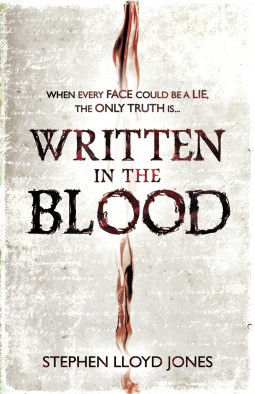
Written in the Blood‘Written in the Blood’ is the sequel to Stephen Lloyd Jones ‘The String Diaries’. If you want to catch up on the plot, you can find my review here.

Set fifteen years after the first novel in the series, the main protagonist in ‘Written in the Blood’ is Hannah Wilde’s daughter, Leah. Last seen as a nine year old girl on the run with her mother from the dangerous Jakab, she is now 24 and on a mission to help save the future of her race – the Hosszu Eletek.

Fertility among the remaining Hosszu Eletek is failing, and Leah is one of the youngest in a declining society. Together with her mother, Leah is helping to run a highly controversial fertility programme to give women the chance to have a child. But the upper echelons of the Hosszu Eletek society aren’t keen on diluting their race with the human blood that runs through Hannah and Leah’s veins. And when they decide that it’s necessary to reach out to the banished Kirekesztett, their fertility programme is soon seen as something that needs to be stopped at any cost. Continue reading

Karen Joy Fowler’s ‘We are All Completely Beside Ourselves’

WeAreAllCompletelyKaren Joy Fowler’s novel ‘We Are All Completely Beside Ourselves’ focuses on a family that has been ripped apart by the loss of a daughter and a sister.

Rosemary was only five years old when Fern disappeared from her life. Years later, her brother leaves home without a backward glance. From a family of five, they are suddenly just three. The family home, once thriving and full of life, is now dominated by the things that they don’t talk about.

Even though she’s never mentioned, Fern has affected every moment of Rosemary’s life, past and present. They grew up together, experienced everything together and even had their own language. Many years later at college, Rosemary is doing everything she can to fade into the background. But sooner or later, she has to face the truth of what really happened to Fern.

To say any more about the plot would ruin it for future readers, but there’s a massive plot twist about half way through that I didn’t see coming – probably because I’d managed to avoid reading any revealing reviews beforehand! Continue reading

Andy Weir’s ‘The Martian’

the martianFollowing an aborted Mars mission, NASA astronaut Mark Watney is left behind. His team think he’s dead. He has no way of communicating with them or with Earth The next mission to Mars is over 4 years away. Its proposed landing site is thousands of kilometres away. But all of that pales in significance beside the more immediate problem – Mark will run out of food long before the next mission arrives and will starve to death.

He has a limited amount of supplies and has to figure out how he can use them in a way that will sustain his life, taking each day as it comes and hoping that a solution to what seems like a completely impossible, hopeless task. He seems doomed to fail and die alone on Mars. But the ways that he finds to survive in such a bleak and inhospitable environment are ingenious. He continues to defy expectations and relies pretty much entirely on his own logic and common sense to carry on.

Be warned, there is a lot of technical detail about the systems for life support in Mark’s makeshift home, and a lot of maths and scientific detail as he attempts to work out how he can survive! I didn’t understand a fair few of the finer points, but it didn’t take anything away from the reading – as long as Mark understood it, that’s all that matters! Continue reading

Reading Resolutions for 2015

As it’s a new year, I thought I’d kick off 2015 with a few of my reading resolutions for the next twelve months…

1. Read more non-fiction books. I very rarely read non-fiction books, but I’d really like to try and change this. Currently sitting on my bookshelf are The Immortal Life of Henrietta Lacks and The Kraus Project, but I’d love any more recommendations.

2. Read more classics. Again, my bookshelf and kindle library are groaning under the weight of all the books I’ve bought with good intentions and never read. Top of the list for 2015 are Anna Karenina, The Grapes of Wrath and Heart of Darkness.

3. Review more of the books I read. I’ve been a bit slow on the reviewing front recently. I’ve been reading tons of books on my kindle at the moment going to and from work on the train, but haven’t had the time to properly sit down and write down all my thoughts.

4. Try and read the books I already own. I have an entire bookcase filled with books that I’ve not read. Some of them have been sat there for years. But still I keep finding myself buying new books, both in hard copy and on my kindle. I’m rapidly running out of space – so something’s got to give!

5. Lots of people seem to be setting reading targets for 2015, aiming to read more than they’ve managed to get through in 2014. Mine is actually the opposite. My final resolution is to stop reading so many quick reads in my favourite genres, and try and focus on some more challenging, and probably more time consuming reads.